
NYC attempts to ban soda
Here's an article about how Mayor Bloomberg of New York wants to ban large sodas at restaurants, delis, sports arenas, etc. He has a photo showing the sugar content in various sodas. I find this demonstration even more effective using actual candy (see the photo in Find Hidden Candy.)


USASEF: The NASA/Design Squad Marshmallow Astronauts
A spacecraft shuttling astronauts to the moon has two challenges. First, it has to slow from 18,000 miles per hour to a safe landing speed. Then it needs to land gently enough to keep the astronauts safe. This challenge, sponsored by NASA/Design Squad at USASEF, was to build a landing craft that could absorb the shock of a landing without bouncing out all the little marshmallow astronauts. (These instructions are adapted from the NASA/Design Squad Touchdown handout.)
Materials:
1 piece of stiff paper or cardboard (about 4*5 in)
1 small paper cup (this holds the astronauts)
3 index cards
2 regular marshmallows (these are the astronauts)
10 miniature marshmallows
3 rubber bands
8 plastic straws
scissors
tape
Build
1. Design a shock-absorbing system (think springs and cushions).
2. Build spacecraft by attaching shock absorbers to the cardboard platform.
3. Tape the cup to the cardboard platform to hold the astronauts. Cup must be right-side up, with no lid--no cheating!
Test
Drop the lander from the height of one foot. If the astronauts fall out, modify your design. For instance, you can
--make sure the weight is evenly balanced so that the lander doesn't tip the astronauts out
--add soft pads or change shock absorbers so astronauts don't bounce out.
The "landers" I saw also had fins or paper wings, which slowed them down as they fell. This must be simulating an Earth landing, as the moon has no atmosphere to slow down a lander, no matter how many wings it has!
 More info about the sponsors at:
pbs.org/designsquad
nasa.gov
Materials:
1 piece of stiff paper or cardboard (about 4*5 in)
1 small paper cup (this holds the astronauts)
3 index cards
2 regular marshmallows (these are the astronauts)
10 miniature marshmallows
3 rubber bands
8 plastic straws
scissors
tape
Build
1. Design a shock-absorbing system (think springs and cushions).
2. Build spacecraft by attaching shock absorbers to the cardboard platform.
3. Tape the cup to the cardboard platform to hold the astronauts. Cup must be right-side up, with no lid--no cheating!
Test
Drop the lander from the height of one foot. If the astronauts fall out, modify your design. For instance, you can
--make sure the weight is evenly balanced so that the lander doesn't tip the astronauts out
--add soft pads or change shock absorbers so astronauts don't bounce out.
The "landers" I saw also had fins or paper wings, which slowed them down as they fell. This must be simulating an Earth landing, as the moon has no atmosphere to slow down a lander, no matter how many wings it has!
pbs.org/designsquad
nasa.gov
Solar Chocolate
This was the coolest candy experiment I've ever done--or maybe the hottest?
Upon realizing (1:30 am last Saturday morning) that the upcoming solar eclipse was a rare annular eclipse that we'd actually be able to see from the southern US, we packed up and started driving south that very day. 26 hours later (we arrived at a Utah mountaintop in time to watch the celestial spectacle as the moon began to cover the sun. To watch the eclipse, we could use a welding face mask, a telescope flipped backwards to project the eclipse onto a white poster, or a pinhole viewer, in which the light goes through a small hole to project the sun's shape.
Here's the solar eclipse as seen through the backwards telescope, with the moon covering most of the sun.

And here's my pinhole solar eclipse viewer.

 See that crescent shape in the middle of the shadow? That's the shape of the eclipse.
Upon realizing (1:30 am last Saturday morning) that the upcoming solar eclipse was a rare annular eclipse that we'd actually be able to see from the southern US, we packed up and started driving south that very day. 26 hours later (we arrived at a Utah mountaintop in time to watch the celestial spectacle as the moon began to cover the sun. To watch the eclipse, we could use a welding face mask, a telescope flipped backwards to project the eclipse onto a white poster, or a pinhole viewer, in which the light goes through a small hole to project the sun's shape.
Here's the solar eclipse as seen through the backwards telescope, with the moon covering most of the sun.

And here's my pinhole solar eclipse viewer.


Mint for the drive
It was a long post-eclipse drive home from Utah, and, as the driver, I had to rely on some mental stimulation. Since I don't drink coffee, and I don't like most sodas, I decided to try something else.
I recently read a Tufts Health & Nutrition email update which described how scientists in Cardiff had shown that chewing flavorless gum doesn't help with cognitive tasks; therefore, "chewing gum is only considered a performance enhancer as long as flavor lasts." Did that mean that mint flavor was a mental stimulant?
I loaded up on wintergreen Altoids, Tic Tacs, and Lifesavers. The Altoids had enough of a sharp flavor to jolt me into hyperawareness, the Tic Tacs made me laugh as my 4-year-old kept asking for "tic tac toes," and as an added benefit, I could let my kids chew the Lifesavers to make sparks in the dark. Perfect driving aids!
I recently read a Tufts Health & Nutrition email update which described how scientists in Cardiff had shown that chewing flavorless gum doesn't help with cognitive tasks; therefore, "chewing gum is only considered a performance enhancer as long as flavor lasts." Did that mean that mint flavor was a mental stimulant?
I loaded up on wintergreen Altoids, Tic Tacs, and Lifesavers. The Altoids had enough of a sharp flavor to jolt me into hyperawareness, the Tic Tacs made me laugh as my 4-year-old kept asking for "tic tac toes," and as an added benefit, I could let my kids chew the Lifesavers to make sparks in the dark. Perfect driving aids!
USASEF SWE Candy Car
When we were at USASEF, one of the booths down the aisle from us left the floor littered with Lifesavers every night. On the last day I hunted them down, to find out what another group was doing with candy.
At this booth, run by the Society of Women Engineers, visitors were challenged to build sailcars and race them to see whose was fastest. The catch: they could only use the following materials:
3 straws
4 Lifesavers
1 small piece of paper
2 paper clips
50 centimeters of tape
Stumped? Here are some hints:
-Mount the Lifesavers on the straws to make wheels (they spin surprisingly well!)
-Turn the piece of paper into a sail you can blow on
With their candy wheels and their breath-catching sails, these little cars worked surprisingly well! Yet another great way to use candy for science.

At this booth, run by the Society of Women Engineers, visitors were challenged to build sailcars and race them to see whose was fastest. The catch: they could only use the following materials:
3 straws
4 Lifesavers
1 small piece of paper
2 paper clips
50 centimeters of tape
Stumped? Here are some hints:
-Mount the Lifesavers on the straws to make wheels (they spin surprisingly well!)
-Turn the piece of paper into a sail you can blow on
With their candy wheels and their breath-catching sails, these little cars worked surprisingly well! Yet another great way to use candy for science.
Half and Half Label
I'm not a coffee drinker, nor am I on a diet, but I was still intrigued by a recent label for "Fat-Free Half & Half."
 How can it be fat-free if it's half cream? A look at the ingredient label showed me the two tricks being used.
 1) The first ingredient listed is skim milk. True, that would have slightly less fat than whole milk. But look what they've added next, probably to compensate: corn syrup.
2) The third ingredient listed is "Cream*" The asterisk is important, because it refers to this note: "Adds a trivial amount of fat." How much? We can't tell. I've noticed on other labels that numbers less than 0.5 have been rounded down to zero (that's apparently why 0.49 g Tic Tacs can contain 0 g sugar.)
1) The first ingredient listed is skim milk. True, that would have slightly less fat than whole milk. But look what they've added next, probably to compensate: corn syrup.
2) The third ingredient listed is "Cream*" The asterisk is important, because it refers to this note: "Adds a trivial amount of fat." How much? We can't tell. I've noticed on other labels that numbers less than 0.5 have been rounded down to zero (that's apparently why 0.49 g Tic Tacs can contain 0 g sugar.)
Fat free? I think not. High-calorie? Yes, especially with all that extra sugar. Deceptive? Absolutely.
Fat free? I think not. High-calorie? Yes, especially with all that extra sugar. Deceptive? Absolutely.
Cereal Labels
Ever since I started candy experiments, I've become way more interested in food labels, especially labels that try to convince you that sugary snacks are health food. Here's a new favorite:
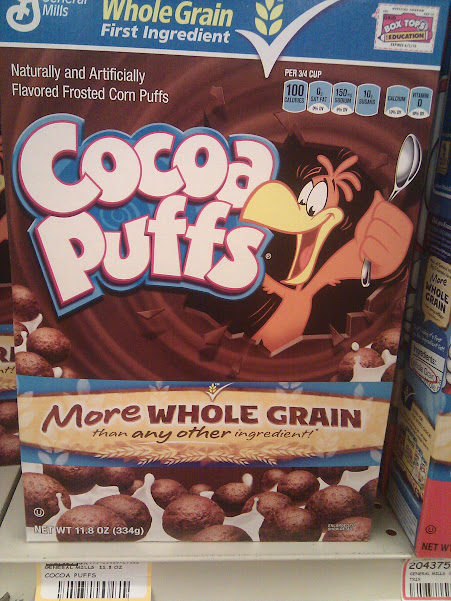 "More whole grain than any other ingredient" sounds like a good thing, because nutrition experts are constantly advising us to eat more whole grain. But look what else you get with all that whole grain:
 That's right. LOTS of sugar, as well as corn syrup. Which means:
 that this candy is more than 1/3 sugar (37%, to be precise).
This snack might make a yummy dessert, but I won't be serving it for breakfast. I won't be serving it for dessert, either. I much prefer cookies.*
*Though I did realize, on the airplane ride home from DC, that serving sugar cereal for dessert might have some advantages. It's so full of air that kids have to eat several pieces of cereal to get the amount of sugar they'd get from a few pieces of candy. In other words, it takes a little bit longer to eat, and on an airplane ride, that matters!
This snack might make a yummy dessert, but I won't be serving it for breakfast. I won't be serving it for dessert, either. I much prefer cookies.*
*Though I did realize, on the airplane ride home from DC, that serving sugar cereal for dessert might have some advantages. It's so full of air that kids have to eat several pieces of cereal to get the amount of sugar they'd get from a few pieces of candy. In other words, it takes a little bit longer to eat, and on an airplane ride, that matters!
Subscribe to:
Posts (Atom)