Showing posts with label gummy worms. Show all posts

Shrinking Gummy Worms

Shrink candy in this science experiment. You can even do this as a gummy worm science fair project.


What to do:

  1. Prepare several cups of water. Measure out salt or sugar and add to each cup. For instance, you might add one tablespoon of salt to one cup, two tablespoons of salt to a second cup, one tablespoon of sugar to a third cup, and so on. (Make sure to write down how much salt or sugar you added to each cup.)
  2. Make a hypothesis (prediction) about which solution will shrink the gummy candy most. Put a gummy worm in each cup of water.
  3. Leave the worms in water for up to two days.
  4. Remove each worm and measure it to see how much it shrank or grew.
  5. Write down your results and to learn if your hypothesis was correct.
You can do this experiment with gummy worms, gummy bears, or any type of gummy candy that contains gelatin.

What's Happening:


Gummy worms contain water, which is what makes them chewy. When you put a gummy worm in a cup of salt water, the water flows out of the gummy worm into the salt water. This is because water naturally flows from a less concentrated solution (the gummy bear) to a more concentrated solution (the salt water). This process is called osmosis.

This experiment can be found in the book Candy Experiments 2.

11 Favorite Candy Experiments

Do you need a fun way for kids to celebrate Halloween and learn science? If so, try some of these candy science experiments to get your candy bubbling, spouting, sparking, sinking, and separating!

Here’s a list of eleven favorite candy experiments from all over the internet.

1. Sour Candy Bubble Test

Sour candy contains acid, which causes the sour taste. With the Acid Test candy experiment, You can test for the acid by dissolving the candy and adding baking soda to make a bubbling reaction.

You can do this with any type of candy, but it’s especially fun with Pixy Stix and Warheads!

2. Floating M&Ms

Need a Halloween magic trick? Drop some M&M’s in a glass of water and watch the letters. In a few minutes, the M’s will start floating!

3. Marshmallow Sink

Can you sink a marshmallow? Take the Marshmallow Challenge to find out!

A marshmallow contains tiny air bubbles, which puff it out to make it less dense than water. To make it sink, you must make the marshmallow denser than water by making it smaller. Smash the marshmallow to break the air bubbles, then roll it into a ball. If you make it small enough, it will sink.

4. Life Saver Lights

For this experiment, which the Exploratorium calls “Lighting In Your Mouth,” you need a dark room, a mirror, and a pack of wintergreen LifeSavers. Stand in front of the mirror and start chewing the LifeSavers. You will see sparks of light as the energy from the chewing motion rips electrons off of the sugar molecules, then recombines them to release flashes of light.

This also works with other wintergreen sugar candies, such as Altoids.

5. Candy Color Separation

Chromatography lets you separate candy colors so you can see what dyes have been mixed together.

To do chromatography, cut a strip of paper from a coffee filter. Wet a colored candy, such as a brown M&M, and dab a spot of color near the bottom of the paper. Stand up the paper up in glass with a half-inch of water, and watch as the colors rise up the paper.

6. Chocolate Bloom

When chocolate blooms, the cocoa butter begins to separate from the cocoa solids. Eventually the cocoa butter can form complex patterns of white crystals.

7. Dancing Gummy Frankenworms

For the Dancing Gummy Frankenworms experiment, you can make gummy worms dance by slicing them into strips, soaking them in baking soda water, then dropping them in vinegar. The bubbles will hold the pieces up so they dance!

8. Giant Gummies

Make your gummy worms grow to double their length with the Giant Gummies experiment. Just put them in water and wait for two days to see how big they get.

9. Bubbling Pop Rocks

To find the secret ingredient in Pop Rocks, put them in water and watch what happens. As the candy dissolves, it releases tiny trapped air bubbles that float to the surface.

10. Melting Races


If you really want to see what your candy is made of, cover a cookie sheet with aluminum foil, line up different types of candy, and heat in the oven at 300 degrees to see what happens. For instance, you’ll see oil spots form on Starbursts, candy bars melt away from their fillings, and taffy turn translucent as the air bubbles contained inside rise to the surface and disappear.

11. Mentos Coke Geyser

One of the internet’s favorite candy experiments, the Mentos Coke geyser lets you send coke spouting into the air. Try it with Diet Coke, and wear clothes that can get wet!

For more fun ideas on how to experiment with candy, check out the candyexperiments.com experiments page!

Incredible Growing Gummies!

Gelatin contains long protein molecules that tangle together to trap water molecules. Because gelatin absorbs so much water, candy containing gelatin acts like a sponge. That’s what makes “The Incredible Growing Gummy Worm” one of our favorite candy experiments.


Soaking gummy candy for two days can make it grow twice as long. As the gelatin molecules form bonds, cross-linking like a jungle gym, they trap water molecules between them.


To turn a gummy worm into a “gummy snake,” fill a flat dish with water and drop in a gummy worm (or several). Set aside a dry gummy worm for later comparison. Check back every few hours to see your gummy worm growing, since it can continue to absorb water for up to two days.

Once your gummy worm has grown to its full length, you can perform tests to see how much it grew.
  • Use a ruler to measure the length of the giant gummy worm, then measure the dry gummy worm and compare.
  • Weigh it and compare its weight with a dry gummy worm. Be gentle, because a water-engorged gummy worm becomes fragile and splits easily, like Jell-O. Try moving it by tipping most of the water out of the dish, laying down some plastic wrap, and sliding the gummy worm onto the plastic to weigh it. Then weigh a dry gummy worm and subtract it from the weight of the giant gummy worm. The remainder is the weight of all the water that was absorbed.


You can also try this activity with other gummy candies, like gummy bears, fruit snacks, or Life Savers Gummies. Check the ingredient labels to make sure that your experimental gummies do contain gelatin. Gummy candies without gelatin, like Swedish Fish, don’t absorb extra water.

Down the Gummy Tunnel

Gummy worms absorb so much water, and grow so much, that they turn translucent. Looking into the broken section of this piece of gummy worm was just like looking down a tunnel, complete with a ridged ceiling.

Can You Eat Giant Gummies? and a book giveaway!

After I wrote a guest blog post about giant gummies for Lisa Bergantz of smmartideas.blogspot.com, she decided to do it on TV. When she demonstrated the gummy experiment on Good Things Utah, she mentioned that she'd dared her kids to taste them, and they tasted awful, because the flavor is so diluted. (You can watch the clip here--the gummy section starts about 2 minutes from the end.)

I started thinking about that. She's certainly right, that the flavor is diluted by all the water the gummies have absorbed. But is there something else going on?

Here is my test gummy worm, which has absorbed so much water and grown so enormous that it no longer fit in the drinking glass, and broke in pieces:

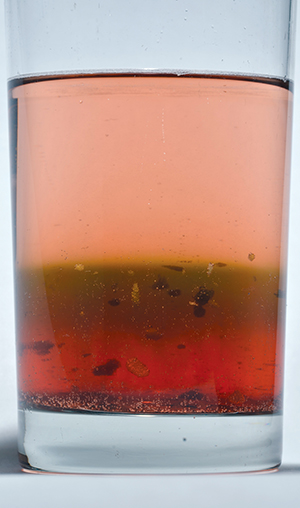
Can you see the cloudy water at the bottom of the cup? Something's been dissolving, and it's probably not the gelatin (which has absorbed all the water that made the gummy grow, and is still holding the gummy together.) I stuck a straw in to find out. Sure enough, the water was sweet and a little candy flavored, kind of like a weak Koolaid. So, not only has the flavor of the gummy been diluted by all the extra water, it's also been diluted because some of the sugar and flavor has dissolved into the water.

(I definitely do not recommend eating the gummies, which are more like weak-flavored Jell-O, or drinking the water. This was done for the sake of science!)

Lisa is also holding a Candy Experiments book giveaway at her blog, smmartideas.blogspot.com. Find out how to enter here!